Country of origin: the papers customs wants on file
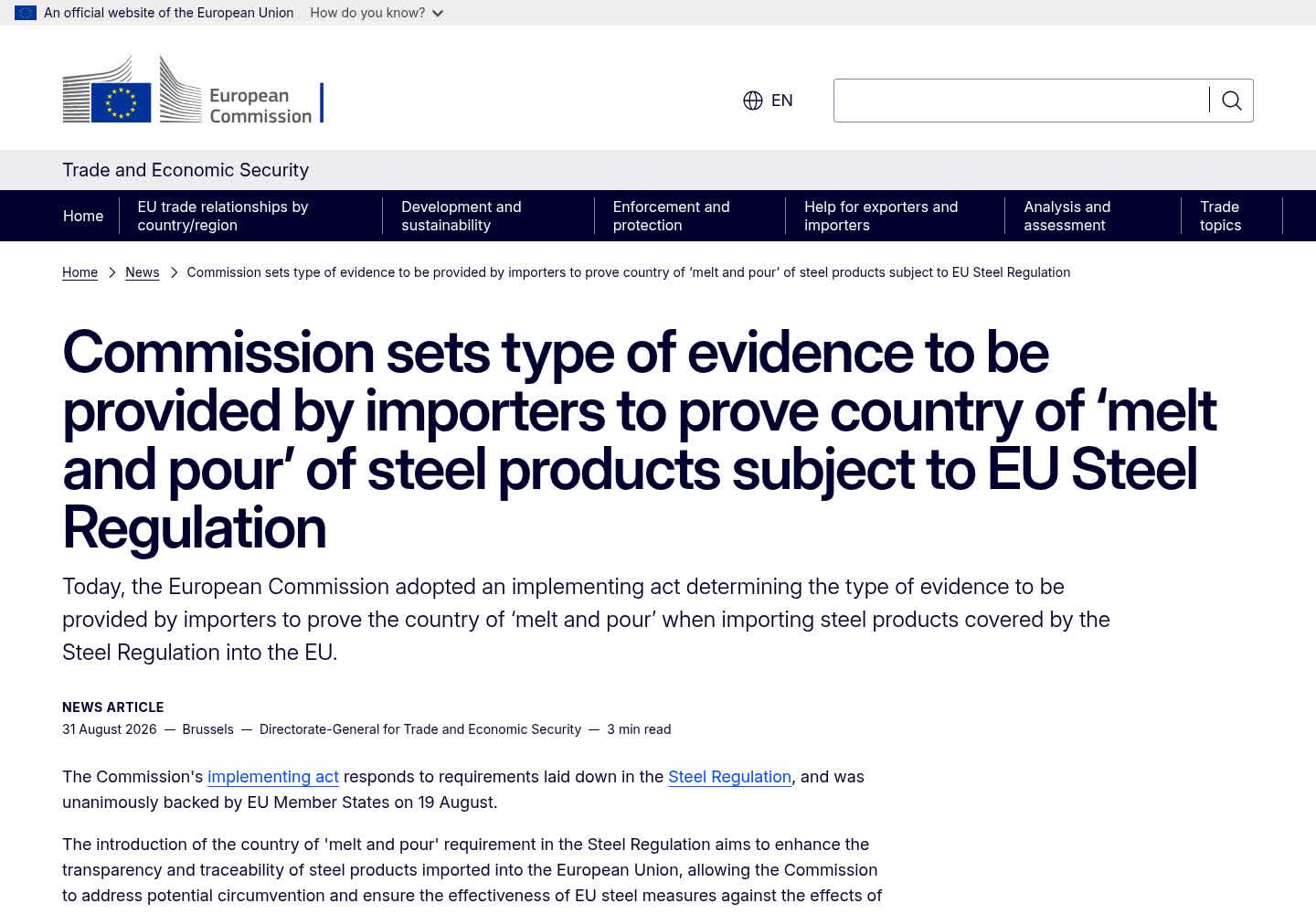
Three documents, and the origin field has to read the same on every one of them. A supplier declaration naming the country of manufacture, dated and renewed with each order. A through bill of lading covering the whole journey, plus a non-manipulation certificate from the transit country's customs if the goods were warehoused on the way. And, for steel going into the European Union, a mill test certificate naming the country where the metal was melted and poured and the heat number of the batch.
The brand's nationality answers none of this. YATO is a Polish name whose owner, TOYA S.A., describes its suppliers as companies located in China; on the entry that is Chinese origin, whatever the lid says.
What changed is that origin has stopped being an argument and become a field to match. From 1 October a container of steel arriving at an EU port without that mill certificate is refused — not delayed, not charged the 50 per cent out-of-quota rate.
A missing declaration "shall lead to a rejection of the import." — Commission Implementing Regulation (EU) 2026/1963, 28 August 2026
For one year, to 30 September 2027, customs may accept an invoice, a quality certificate, a purchase-order clause or a supplier declaration on their own where the certificate is missing. After that they count only alongside it, never instead of it. Hand tools are not on the covered list; the mechanism is what reaches them next.
Three tests, one origin field
All three can be run against the same shipment. Know which one the buyer's customs authority is applying before you answer their question.
| Rule | In force | What it tests | What you produce |
|---|---|---|---|
| EU melt-and-pour, Regulations 2026/1384 and 2026/1963 | 1 October 2026; alternative evidence allowed to 30 September 2027 | Where the steel was melted and poured | Mill test certificate with melt-and-pour country and heat number |
| US substantial transformation | Long-standing | Whether processing produced a new name, character or use | Bill of materials, manufacturing records, where each major component was made |
| Direct consignment, under most free-trade agreements | Varies by agreement | Whether the goods were altered in a transit country | Through bill of lading; non-manipulation certificate if warehoused in transit |
Where the metal was melted is a fact a furnace wrote down. Whether processing gave a product a new name, character or use is an argument, and US Customs still runs it case by case. Enforcement is moving towards the fact: Fortune reports that the August enforcement plan screens shipment data against routing histories and ownership records. A screen does not weigh arguments. It matches fields, which is why your invoice, packing list, certificate and entry all have to say the same thing.
The transit trap
This is the row that catches importers who did everything else right. A preferential certificate of origin assumes the goods came straight from the exporting country. A container that leaves a factory, sits a week in a hub-port yard and boards a different vessel has broken that on its face, and the authority may set the certificate aside and charge the full rate.
The defence is the through bill of lading covering the whole journey and, if the goods were warehoused, the non-manipulation certificate. Neither can be produced after the fact, so ask the forwarder which routing the box is actually on rather than which one was quoted.
Transshipment itself is not the offence — almost everything out of Asia touches a hub. The offence is declaring an origin the paperwork cannot support, and the penalty follows the importer of record who signed the entry, not the factory that put the sticker on the carton.
Two housekeeping habits close most of the exposure. Renew the supplier declaration with every order, because a factory that moves a line does not write to its distributors. And if any steel you handle is going on to Europe, ask for the heat number now; a view, not a rule yet, but the Commission's downstream-product review is due by 30 June 2027 and the alternative-evidence window closes three months later.
Before you order a line, ask Vesprr Tools for the country of origin by part number and we will confirm what the authorised dealer can document. It costs nothing now and it is the only thing that helps in a customs query a year later.
Sources
- Commission Implementing Regulation (EU) 2026/1963 of 28 August 2026 — EUR-Lex. The mill test certificate requirement, the alternative-evidence list, the transition dates and the rejection wording.
- European Commission, Directorate-General for Trade and Economic Security, Commission sets type of evidence to be provided by importers to prove country of 'melt and pour', 31 August 2026.
- CMS, Unprecedented EU steel regulation targets global overcapacity — Regulation (EU) 2026/1384, the 50% out-of-quota duty and the 30 June 2027 downstream-products assessment.
- Fortune, Trump trade enforcers deploy AI in tariff evasion crackdown, 13 August 2026 — screening of shipment data against routing histories and ownership records.
- U.S. Customs: Why Country of Origin Is Under More Scrutiny, The Direct Consignment Rule Most Importers Don't Know and The Tariff Evasion Scheme That's Landing Importers in Prison, by Ask The Customs Manager — substantial transformation, through bills of lading, and importer-of-record liability.
- Vesprr Tools, YATO tools: Polish name, Chinese build, and what to ask, 13 September 2026 — TOYA S.A.'s own description of its suppliers.