Do you need insulated tools to work on a hybrid or EV?
Yes, for any job on the high-voltage system: the battery, the orange cables, the inverter and the drive motor. They are the second layer of protection, not the first. The UK Health and Safety Executive (HSE) says the system must be isolated and proven dead before work starts. It then says that parts can still hold a high voltage after isolation, which is why the tools should be insulated. Work that never touches the high-voltage side is done as on any other car.
The earlier post on what IEC 60900 covers explained the standard behind the VDE mark. This one is about when a vehicle job needs it.
Why insulate tools if the system is switched off?
Because "off" is not "dead". HSE's guidance for motor vehicle repair lays out the order:
"Even when isolated, vehicle batteries and other components may still contain large amounts of energy and retain a high voltage. Only suitable tools and test equipment should be used. These may include electrically insulated tools and test equipment compliant with GS38." Health and Safety Executive, Electric and hybrid vehicles
A battery pack stays charged whatever you do to the rest of the car. Some components store energy after the battery is isolated, and HSE says to follow the maker's data on discharging it. After a crash it may not be possible to isolate the system fully at all. In each case a spanner that slips between two terminals is the risk, and an insulated one is what stops it becoming a shock or an arc.
The sequence HSE gives is:
- Check the car for damage to the orange high-voltage cabling before any work.
- Isolate the high-voltage battery and lock it off, following the manufacturer's instructions.
- Test and prove dead every cable or component you will touch.
- Then work, with insulated tools and test equipment.
Insulated tools do not let you skip steps 2 and 3. HSE says workshop staff doing repairs will "need a much greater level of competence" than people who sell or valet these cars, and points to the Institute of the Motor Industry (IMI) for qualifications.
Which jobs need them, and which do not?
The line is the high-voltage system, not the car.
- Insulated tools: the battery pack, the orange cables and their connectors, and the parts those cables feed, such as the inverter and drive motor, plus any work close to their terminals.
- Ordinary tools: tyres, brakes, suspension, wipers, lights and other 12 V jobs that stay away from the high-voltage parts. HSE notes that other vehicles run on 12 or 24 V DC, and the 12 V system in a hybrid or EV is the same kind of system.
If a job takes you near the orange cabling, treat it as high-voltage work, even if you came to change something else.
What rating do the tools need?
IEC 60900, the standard behind the VDE mark, covers hand tools for live working up to 1,000 V AC and 1,500 V DC. HSE puts the electric and hybrid cars on the road today at up to 650 V DC, so a tool made and marked to IEC 60900 covers them with room to spare. Check that the rating is printed on the tool itself, not only on the box, as the earlier post explains.
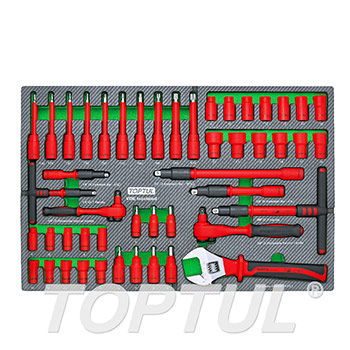
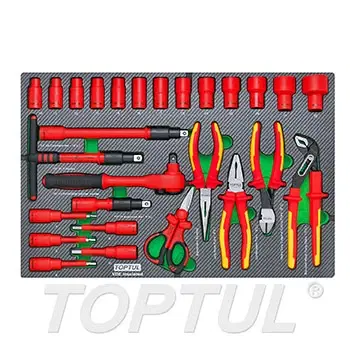
For a workshop starting out, the tools that do most high-voltage jobs are sockets with an insulated ratchet and extension, screwdrivers, and pliers or cutters for clips and cable ties. Toptul's GED2764 puts 1/2" drive VDE sockets, pliers and scissors in one tray. GED4863 covers the smaller 1/4" and 3/8" fasteners. Buying them as a set also keeps the insulated tools together, separate from the everyday ones, so nobody grabs an uninsulated extension halfway through a job.
The tester is a separate purchase: HSE asks for test equipment compliant with GS38, its guidance on test probes and leads, and the vehicle maker may name a specific one.
See the insulated sockets, screwdrivers and pliers in the VDE insulated tools range, and send the part numbers you want quoted.
Sources
- Electric and hybrid vehicles, Health and Safety Executive (UK).
- EVS-EN IEC 60900:2018, Live working: hand tools for use up to 1 000 V AC and 1 500 V DC, Estonian Centre for Standardisation and Accreditation.
- VDE Insulated & General Electrician's Tools, Vesprr Tools catalogue: GED2764, GED4863 and their images.