How to prove a powered torque tool is still on target
To prove a powered torque tool is still on target, measure the joint rather than the tool. Mark a fastened joint, apply force in the tightening direction with a calibrated hand torque instrument, and read the value at the moment the fastener first moves. That reading is what the joint actually received; the number on the tool's own display is what its transducer saw on the way in, which is not the same thing and is not evidence a customer or an auditor will accept.
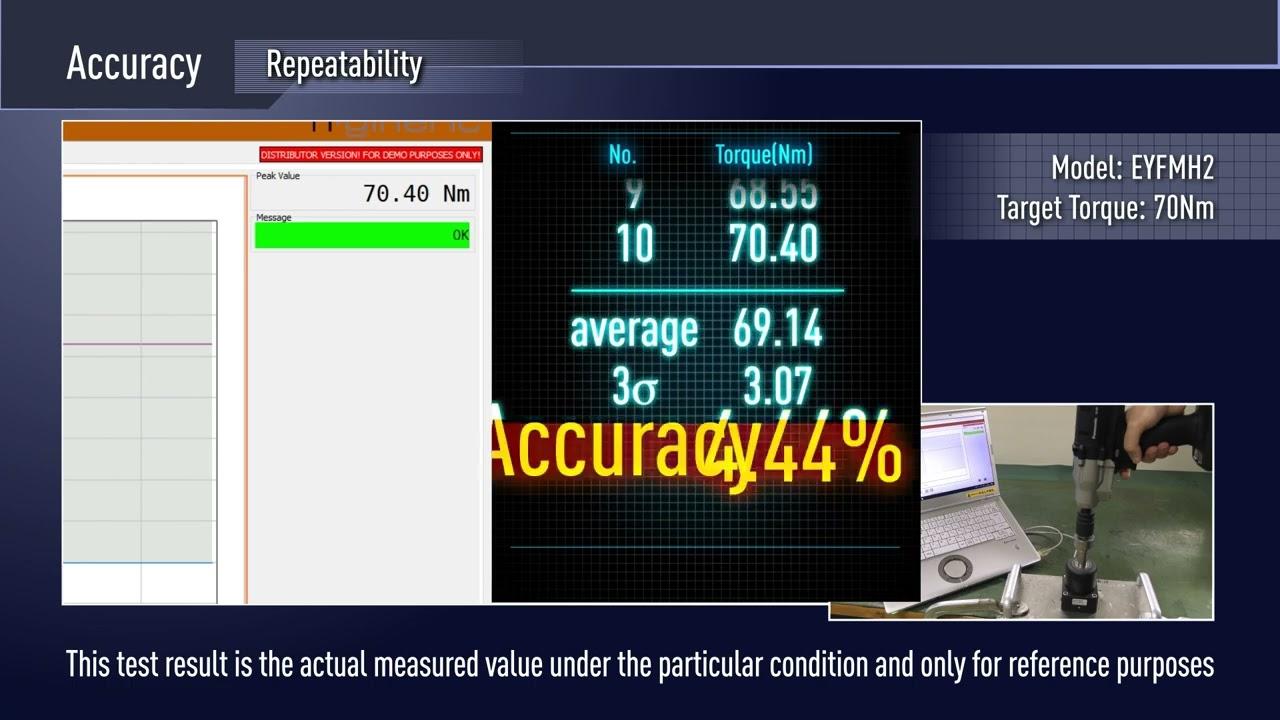
The gap between the two is visible in the tool makers' own demonstrations. Panasonic's accuracy film for the AccuPulse pulse tool sets an EYFMH2 to a 70 N·m target, runs ten joints, and shows an average of 69.14 N·m with a 3σ of 3.07 — then captions the screen "This test result is the actual measured value under the particular condition and only for reference purposes". That caption is the point. A bench result under one set of conditions, on one joint, says nothing about the joint on your line six months later with a different washer, a longer fastener and a worn socket.
Which audit method to use
Use the first movement test. Mountz sets out three ways of checking torque on an assembled joint, and describes first movement — marking the fastener and applying force in the tightening direction until it just moves — as the best way to determine residual torque. The loosening test reads the value at which the fastener breaks free in the undoing direction. The marking test loosens the fastener and retightens it until the marks realign.
All three carry the same caveat, and it is the one that catches people out: friction behaves differently during a dynamic rundown than it does on a static joint, so the audit reading will not match the torque the tool applied. Residual torque is a different quantity from applied torque, and Mountz is explicit that the difference has to be accounted for when the residual torque specification is engineered. The practical consequence is that you do not write "audit must read 70 N·m". You run the audit on a joint you know is good, record what it reads, and set the audit limits around that.
What to audit with
The instrument has to be better than the tolerance it is policing, and it has to be the kind of instrument that can be calibrated and certified — which rules out reading the audit off the powered tool that set the joint.
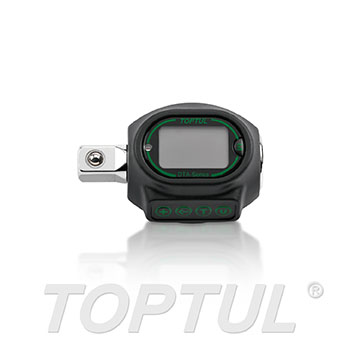
Two formats do the job. A digital torque adapter fits between a ratchet handle and the socket: the DTA-030N, DTA-135N and DTA-200N hold CW and CCW accuracy to ±2% of the set value, with the smallest of the three at ±3%. A digital torque wrench is a complete instrument: the DT-030N, DT-100N and DT-200N hold ±1% clockwise and ±1.5% counter-clockwise. Both are tested and certified to DIN EN ISO 6789 and BS EN 26789, both carry peak-hold mode so the reading survives the moment the fastener moves, and both are rated for reading accuracy over a minimum of 5,000 tightening cycles.
Pick the range so your target sits in the middle of the scale rather than at either end, and pick the format by who is holding it. The adapter is the cheaper way to cover several drive sizes, because it works with the ratchets on the bench already. The wrench is the one to sign an audit with: tighter accuracy, and a memory that holds 100 readings against the adapter's 10, which matters when a shift's worth of checks has to come off the tool and into a record.
Run the check on a fixed schedule rather than after a complaint, and run it on the real joint rather than a test block — the test block is where the powered tool always looks right.
Ask Vesprr Tools for a digital torque adapter or wrench in the band you audit, and say which drive sizes you run.
Sources
- Three Proven Methods of Verifying Torque Specifications — Mountz Torque. First movement, loosening and marking tests, and the residual-versus-applied torque caveat.
- Panasonic AccuPulse 4.0 Assembly Tools Video Series: Accuracy by Panasonic Indoor Air Solutions NA — the EYFMH2 repeatability run and the on-screen "for reference purposes" caption. The header image is a frame from this video.
- How To Set And Verify The Torque Output of a Panasonic Mechanical Pulse Tool by Air Power Manufacturing Solutions — the set, break away, compare and adjust routine as a distributor demonstrates it.
- Digital Torque Adapter, DTA-030N / DTA-135N / DTA-200N — Toptul. Accuracy, ISO 6789 certification, peak hold, memory and cycle rating.
- Digital Torque Wrench, DT-030N / DT-100N / DT-200N — Toptul. Accuracy, certification and 100-reading memory.