Is a more accurate torque wrench worth the money?
Not as the first thing you buy. The gap between a click wrench rated ±4% and a digital one rated ±1% is three percentage points. The gap between a click wrench in regular use and the same wrench left wound up on a shelf for six months is sixteen to eighteen. Buy the means to check what you already own, get the storage habit right, and only then spend on accuracy.
That is not a guess about handling. It is what comes off the benches when people put wrenches on calibrated meters and publish the readings.
What the benches found
| Wrench | Set to | Read | Error | Bench |
|---|---|---|---|---|
| Indestro beam wrench, about 50 years old | 100 lbf·ft | 97.7–98.3 | ~2% low | Jason Explains Things |
| Tekton clicker, 8 years old, rated ±4% | 50 lbf·ft | 52.8–53.7 | 6.7% high | Jason Explains Things |
| Harbor Freight Icon, rated ±4% clockwise | 50 lbf·ft | 52.6–56.5 | 10.3% high | Jason Explains Things |
| $19 clicker, in regular use | 80 lbf·ft | 78.9–81.2 | within 2% | Torque Test Channel |
| Same clicker, 6 months stored at maximum | 75 lbf·ft | 61.9–64 | 16–18% low | Torque Test Channel |
| 10-year-old clicker, then adjusted with a screwdriver | 50 lbf·ft | 44–45.9, then 49.0–50.9 | ~10% low, then within 2% | Carsntoys |
Read down the error column and the badge on the handle explains almost none of it. A fifty-year-old beam wrench — a spring-steel bar and a pointer, with nothing in it that can drift — beat two modern clickers on a ±0.5% checker. Both clickers were worst at the bottom of their range, where a 50–250 lbf·ft tool is being asked for 50. And the largest error anywhere came from a wrench nobody touched for half a year.
The mechanism is ordinary. A click wrench is a preloaded spring holding a ball in a detent. Hold that spring compressed for months and it takes a set, so the ball releases early and the wrench reads low. The ten-year-old wrench on the Carsntoys bench had been stored sensibly, had drifted about 10%, and came back inside 2% after five minutes with a screwdriver and an adjustable spanner. Winding the handle back down to the bottom of the scale — around 10 lbf·ft, not to zero — is the highest-return maintenance in the building, and it is free.
"We find price equals features and warranty." — You're Using a Torque Wrench Wrong: MythBusting 10 Do's & Dont's, Torque Test Channel
What to buy, in what order
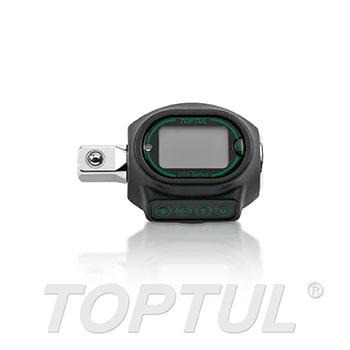
First, the checker. A digital torque adapter sits between wrench and socket and tells you what the wrench is really doing. Toptul's DTA-030N, DTA-135N and DTA-200N read peak or track, hold ten readings, are rated ±2% clockwise and anticlockwise (±3% on the 30 N·m size) for a minimum of 5,000 tightening cycles, and are tested and certified to DIN EN ISO 6789. One adapter checks every wrench on the premises, the digital ones included, and turns a courier run into a five-minute bench job.
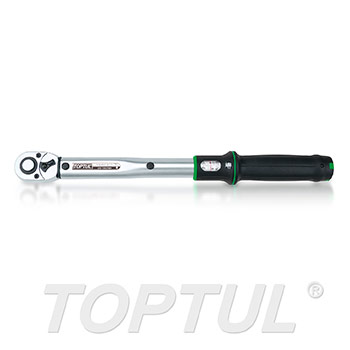
Second, a click wrench chosen for range rather than badge. Toptul's ANAC series is rated ±4% clockwise and its ANAM micrometer-adjustable wrenches come in a spread of drive sizes and torque bands; pick the band that puts the torques you set every day in the middle of the scale, not at the bottom. If you need more coverage than one wrench gives, buy a second smaller one rather than a dearer version of the first, because bottom-of-scale is exactly where both test clickers failed.
Third, and only where the job calls for degrees of rotation on torque-to-yield fasteners, a digital wrench such as the DT-030N. It is the right tool for that job and an expensive way to buy three percentage points for any other.
Vesprr Tools carries 211 lines across wrenches and torque wrenches, from Toptul, Total Tool, Yato, Hoteche and Intough. Send the torque bands and drive sizes you work in and you will get back the adapter, the wrench and the second range to cover the gap.
Sources
- You're Using a Torque Wrench Wrong: MythBusting 10 Do's & Dont's — Torque Test Channel. The $19 clicker in regular use and after six months stored at maximum, measured on a bolt-tension dyno.
- Old Beam Torque Wrench VS New Tools! WINNER WILL SHOCK YOU! — Jason Explains Things. The Indestro beam wrench against a Tekton and a Harbor Freight Icon on a ±0.5% digital checker.
- Is Your Torque Wrench Accurate? | How to Test or Calibrate your Torque Wrench — Carsntoys. A ten-year-old click wrench checked and then adjusted at home.
- Digital Torque Adapter DTA-030N / DTA-135N / DTA-200N — Toptul. Accuracy, the 5,000-cycle rating, peak and track modes, and the DIN EN ISO 6789 certification.
- ISO 6789-2:2017, Assembly tools for screws and nuts — Hand torque tools, Part 2: Requirements for calibration and determination of measurement uncertainty — International Organization for Standardization.
- Toptul ANAM and DT-030N listings, and the ANAM image, from the Vesprr Tools catalogue, checked 24 September 2026.