New Tashkent hardware fair: take a stand or go as a buyer?
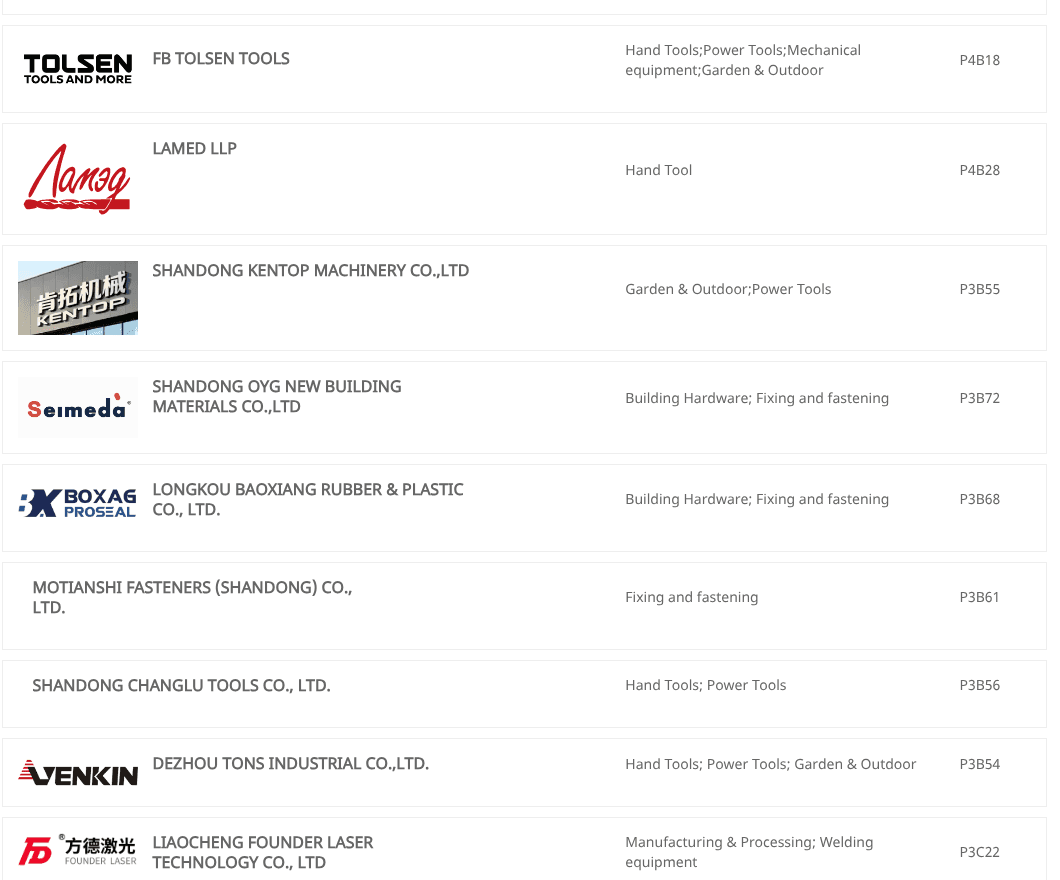
Go as a buyer. Of the 139 companies on the Central Asia International Hardware Expo's exhibitor list this week, 131 are Chinese factories or export houses. A distributor who takes a stand in that hall is selling their goods, next to them, at their price. The badge that pays for itself is the hosted buyer's: the organiser covers the shuttle and the accommodation for procurement managers who pre-book at least five meetings, and the exhibitor list is a sourcing directory with booth numbers that costs nothing to read before you go.
The fair runs from 24 to 26 November at the Uzexpocentre in Tashkent, pavilions 3 and 4. It is a first edition, organised by Koelnmesse with the China Chamber of Commerce for Import and Export of Machinery and Electronic Products as its partner, which is most of the explanation for the exhibitor mix.
Who is on the list
Eight companies out of 139 are not Chinese: KNIPEX from Germany, Toolflex of Sweden, the French abrasives makers Primex and SEA, the Italians Consiglio Abrasivi and Ambro-Sol, the Korean stapler maker Jeil Tacker, and LAMED of Kazakhstan, the only Central Asian company exhibiting at all. The regional trade is not on the stands. It is the audience, which is exactly what the hosted buyer programme is built to deliver.
The Chinese names are the reason to read the list, because several of them are the factories behind lines you already stock under somebody else's label. These are worth booking:
| Exhibitor | Booth | What its own entry claims |
|---|---|---|
| Yato Tools (Jiaxing) | P3B03 | The Chinese arm of Poland's TOYA S.A.; distribution in over 120 countries |
| Hangzhou Huafeng Big Arrow | P3B13 | 20 million sockets a month; 40% to Europe, 35% to the United States |
| Zhejiang Kende | P3A03 | 1.5 million welders a year, $52m of export sales |
| Zhejiang Jonway | P3B36 | Piston air compressors; supplies Husky, DeWALT, Ryobi, Stanley and AEG |
| Taizhou Bison Machinery | P3B37 | Generators, pumps and pressure washers; $56m of exports in 2025 |
| Laizhou Hongyuan | P4B48 | Bench vices since 1998, 500 staff on a 100,000 m² site |
| Hangzhou Source Tool | P4A09 | Torque wrenches, ratchet wrenches and socket sets |
Read from the exhibitor list on 24 September 2026. The list has grown from 91 names in mid-September, so check for later additions before you book.
Qualifying for the hosted buyer programme is a job title and a form: the organiser asks for senior management or procurement roles in the hardware trade, you pre-register and tick “willing to join”, you state your products of interest as precisely as you can, and once approved you pick at least five meetings from the list the organiser sends back. Precision in that one field is what decides whether the five meetings are useful, so name part types and volumes rather than categories.
What the list says about your own suppliers
More than the fair does. An exhibitor entry is a company telling you where it intends to sell next year, and it says so earlier and more plainly than its annual report will. Yato Tools (Jiaxing) is the clearest case: TOYA's own half-year reporting points its Chinese subsidiaries at the Gulf, Africa and South America, and the Jiaxing company has now booked a booth in Tashkent. That is a distributor appointment in Central Asia being planned before it is announced.
The same reading works on your side of the ledger. Run your supplier list against the 139 names. A factory that supplies your brand and is exhibiting in the market next to yours is showing you its export plan for 2027 in the form of a booth number, and it is a better use of an afternoon than the walk round the hall will be.
Vesprr Tools carries Toptul, TOTAL, Yato, Hoteche and Intough. If a factory on that list makes something you are quoting on, ask us and we will tell you whether we already carry it.
Sources
- Central Asia International Hardware Expo: List of exhibitors, all 139 entries across seven pages with booth numbers and company self-descriptions, read 24 September 2026; Facts and Figures for the dates, venue, organiser and the CCCME partnership; About Hosted Buyer Programme for the qualifying titles, the five-meeting requirement and the shuttle and accommodation.
- Vesprr Tools, 13 September 2026: What YATO actually is, on TOYA S.A.'s half-year filing and its Chinese subsidiaries.