What torque wrench do you need for truck wheel nuts?
You need a 3/4-inch drive click wrench rated to about 800 N·m, or a torque multiplier driven by a smaller wrench. Truck, bus and trailer wheel nuts on M22 studs are commonly tightened to 550–650 N·m, beyond the range of any 1/2-inch wrench. Buy the tool whose scale puts your maker's figure in its upper half, and that someone can actually pull.
The rest of this page covers where the figure comes from, what each option costs you in effort and accuracy, and the one sum people get wrong with a multiplier.
Where does the torque figure come from?
It comes from the axle or vehicle maker, never from a chart of "typical" values. The figure also comes with a method, and the method changes the result. Sisu's service bulletin for its M22×1.5 wheel nuts is a good example:
"Oil the threads and the sliding surface between the nut and its washer lightly. Tighten the wheel nuts to 550...650 Nm torque." — Sisu Akselit, service bulletin S11003
The same bulletin gives a tightening sequence. It also requires a torque check "at the latest after one day's driving". The same torque on dry threads gives a different clamping force from the same torque on oiled ones. So read the figure, the thread condition and the sequence from your own vehicle's manual, and buy for the highest figure in your fleet.
Which torque wrench reaches it?
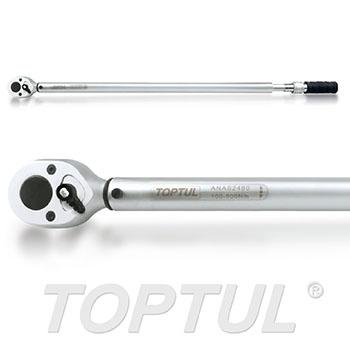
A 3/4-inch drive click wrench whose range runs well past your figure. Toptul's ANAS2480 is a good fit: 3/4-inch drive, 100–800 N·m, 1,000 mm long, rated ±4% clockwise. Set to 600 N·m, it is working at 75% of its scale: inside the range, with room to spare. A wrench that tops out at your exact figure leaves you no headroom. One whose scale starts near your figure is too big for anything else in the bay.
The cost of a long wrench is effort. Torque is force times length, so 600 N·m on a 1 m wrench needs a steady pull of at least 600 N. That is the weight of about 61 kg, held square to the handle until the wrench clicks. In a pit, on a roadside or at the top of a wheel, that is hard to do smoothly, and a click wrench pulled in a jerk overshoots.
Whatever you buy, it only holds its rating while it is calibrated. If you are weighing a cheaper wrench against a dearer one, what extra accuracy actually buys you covers the trade-off.
When is a torque multiplier the better buy?
When the pull is the problem. A multiplier is a gearbox: you turn a small wrench at the input, a reaction arm braces against the next nut or the wheel, and the output turns the nut at several times your input torque.
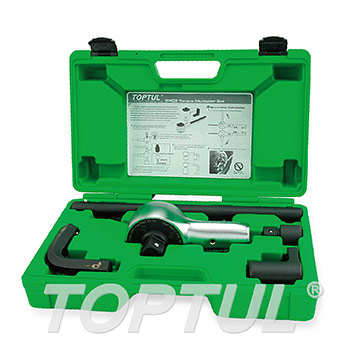
Toptul's ANBE2432 set has a 3/4-inch female input and a 1-inch male output, with a reaction arm, a 90° reaction arm and base, and a safety break-away adapter.
The mistake is in the ratio. The set is sold as 1:4, but that is the gear ratio. Its torque ratio is 1:3.3, because the gears lose some of what you put in. Divide by the wrong number and you under-tighten every nut:
- Right: 600 N·m ÷ 3.3 = 182 N·m at the input.
- Wrong: 600 N·m ÷ 4 = 150 N·m at the input, which gives about 495 N·m at the nut. That is below Sisu's 550 N·m minimum.
182 N·m is within reach of an ordinary 1/2-inch click wrench, with a 1/2-to-3/4-inch adaptor on the input. The pull drops to something one person can hold steady.
The price of that is accuracy. Toptul rates the multiplier's torque accuracy at ±10%, so 600 N·m means 540–660 N·m at the nut. That is roughly the width of Sisu's whole band. If your maker's band is narrower, use the 3/4-inch wrench for the final pass, or check the nuts with it afterwards.
Do you need to check the nuts again?
Yes. Check them with the same wrench after the first stretch of driving, within whatever distance your vehicle maker sets. Sisu's limit is one day's driving at the latest. Set the wrench to the specified figure and pull each nut in sequence until it clicks. A nut that turns before the click had dropped below the figure.
Next step: see the Toptul ANAS2480 3/4-inch torque wrench and the ANBE2432 torque multiplier set in the catalogue. To check which one suits your fleet's figures, ask Vesprr for a quote.
Sources
- Sisu Akselit Oy, Service bulletin S11003: Change in the wheel nut (M22X1.5) tightening torque.
- ToolBuy, Toptul ANAS2480 specifications (range, length, accuracy).
- Techno Instruments, Toptul ANBE2432 specifications (gear and torque ratio, accuracy, maximum output, contents).