How often does a digital torque adapter need calibrating?
Yes. A digital torque adapter is a torque instrument like any other, and the ISO 6789 default for hand torque tools is a calibration every 12 months or 5,000 load cycles from first use, whichever comes first, unless your own quality procedure sets a different interval. Check it sooner after a drop or after it has been pulled past the top of its range. Between lab calibrations, ten minutes with a known weight and a measured bar tells you whether it is still inside its rated accuracy.
This matters more for an adapter than for a wrench, because of how it is usually bought. The earlier posts on torque wrench accuracy and on whether an adapter can replace your torque wrench both recommend it as the tool that checks every other wrench in the workshop. If the adapter has drifted, every wrench you check against it inherits the error.
Where does the interval come from?
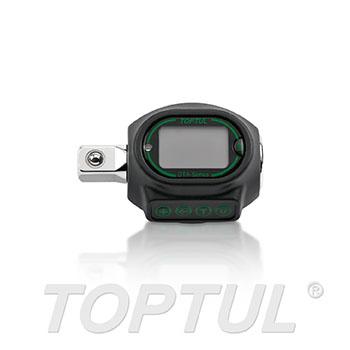
From the standard the adapter is built to. Toptul's DTA-030N, DTA-135N and DTA-200N adapters are tested and certified to DIN EN ISO 6789, and Toptul rates them to hold their accuracy (±2%, or ±3% on the DTA-030N) for at least 5,000 tightening cycles. The German toolmaker Elora summarises the standard's default as "a service life of 12 months or 5000 load cycles as the interval", starting from the tool's first use.
Count cycles honestly. A workshop that uses the adapter to tighten wheel nuts all day reaches 5,000 well inside a year; one that only checks wrenches with it may take years. The 12-month limit applies either way: the standard counts time as well as use.
How do you check it yourself?
Hang a known weight from a bar at a known distance and compare the display with the arithmetic. Torque in N·m is mass in kg × 9.81 × distance in metres, measured from the centre of the square drive to the point where the weight hangs.
- Fix the drive. Clamp a hex bolt head in a vice, fit a socket to it and the adapter to the socket, so nothing can turn.
- Fit a bar and keep it level. Put a breaker bar or ratchet on the adapter, horizontal. A bar tilted 10° shortens the effective lever and reads about 1.5% low.
- Count the bar's own weight. Weigh the bar and find its balance point. Its torque is its mass × 9.81 × the distance from the drive centre to that point. A 0.6 kg bar balancing 200 mm out adds 1.2 N·m.
- Hang the weight slowly. Use a cord loop at a marked distance and lower the weight gently in track mode, so a jolt does not set a false peak. Weigh the load on a scale you trust rather than relying on the number stamped on it.
- Check in the direction you use, at the torque you set most and at one point near the bottom of the range.
A worked example for the 3/8" DTA-135N, which reads 27–135 N·m: 20 kg hung 0.40 m out is 20 × 9.81 × 0.40 = 78.5 N·m, plus the bar's 1.2 N·m, so 79.7 N·m. At ±2%, the display should read between 78.1 and 81.3 N·m. For the low point, 10 kg at 0.30 m plus the bar is 30.6 N·m, so 30.0 to 31.2.
What if it reads outside its tolerance?
Repeat the check first: re-measure the distance, level the bar and fit a fresh battery. A home check carries its own errors. A 2 mm mistake on a 400 mm lever is 0.5%. If the adapter is still outside its rated accuracy, stop using it to check other wrenches and send it to a calibration lab that works to ISO 6789-2. Ask for a certificate that states the readings found before any adjustment. That tells you whether the jobs done since the last check were affected.
Keep a simple record: the date, the weight and distance used, what the adapter read, and the cycle count if you track one. When a customer or an auditor asks how you know your torque figures are right, that record is the answer.
If your adapter is due, or you have not got one yet, see the Toptul DTA digital torque adapters in the Vesprr Tools catalogue and pick the size that puts your most-used torque mid-range.
Sources
- Digital Torque Adapter DTA-030N / DTA-135N / DTA-200N, Toptul: ranges, accuracy, 5,000-cycle rating, peak and track modes, DIN EN ISO 6789 certification.
- Calibration service, ELORA Werkzeugfabrik: the ISO 6789 default of 12 months or 5,000 load cycles from first use.
- ISO 6789-2:2017, Hand torque tools: requirements for calibration and determination of measurement uncertainty, International Organization for Standardization.
- Toptul DTA listing and header image, from the Vesprr Tools catalogue, checked 19 October 2026.